|
 Ames Lab, DOE, ISU, Ames, Iowa Ames Lab, DOE, ISU, Ames, Iowa
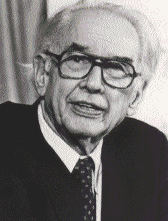
JOHN VINCENT ATANASOFF was born on 4 October 1903 a few miles west of
Hamilton, New York. His father was a Bulgarian immigrant named Ivan
Atanasov. His last name was changed to Atanasoff by immigration officials
at Ellis Island when he arrived with an uncle in 1889, and later on, his
first name was changed to John.
His mother was Iva Lucena Purdy, a mathematics schoolteacher. The
couple had nine children (one of whom died): John, Ethelyn, Margaret,
Theodore, Avis, Raymond, Melva, Irving. After John Vincent's birth, his
father accepted an electrical engineering position is Osteen, Florida, and
subsequently, in Brewster, Florida. It was here that JV completed grade
school and started understanding the concepts of electricity. The
Atanasoff home in Brewster was the first house they lived in with
electricity, and JV, as a 9-year-old boy found and corrected faulty
electric wiring in a back-porch light.
His grade school years were very normal. JV was a good student and had
a youthful interest in sports, specially baseball. This interest in
baseball faded when his father purchased a new Dietzgen slide rule to help
him at his job; JV became totally fascinated with it. He carefully read
the instructions, and was amazed that he could get correct answers. His
father soon discovered that he didn't have an immediate need for the slide
rule, and it was soon forgotten by everyone except young John Vincent.
He soon became interested in the mathematical principles behind the
operation of the slide rule and the study of logarithms; this led to
studies in trigonometric functions. With the help of his mother, he read
A College Algebra, by J.M. Taylor. This book included a beginning
study on differential calculus and also had a chapter on infinite series
and how to calculate logarithms. Within a few months, the precocious
9-year-old had progressed beyond the point of needing help. During this
time, he learned about number bases other than ten from his mother; this
led him to study a wide range of bases, including base-two.
When John Vincent was to enter high school, the family moved to a farm
in Old Chicora, Florida. He completed the Mulberry High School course in
two years, excelling in science and mathematics. He had, by then, decided
he wanted to be a theoretic physicist. In 1921, he entered the University
of Florida in Gainesville. Since the university did not offer a degree in
theoretic physics, he started taking electrical engineering courses. While
taking these courses, he became interested in electronics and continued
onto higher mathematics. He graduated from the University of Florida in
1925 with a Bachelor of Science degree in electrical engineering. He had a
straight "A" academic average. Even though he had many offers of teaching
fellowships, including one from Harvard, he accepted the one from Iowa
State College, because it was the first one he received and because of the
institution's fine reputation in engineering and sciences.
So it was, that one day in the summer of 1925 the 22-year-old boarded
the train that took him to Ames, Iowa, home of Iowa State College. He was
ready to make his mark in the world of science. From September to November
he was busy working on his master's degree and teaching two undergraduate
mathematics classes. Even though his social life was minimal due to his
busy schedule, he was familiar with one campus organization, the Dixie
Club, a club organized for southern students away from home. One evening,
he decided to drop by the club to see what was going on. There he met Lura
Meeks, a beautiful, brown-haired, blue-eyed 25-year-old home economics
major from Oklahoma. This chance meeting led to another date, and then
another. Soon they were best friends, seeking each other's company.
In June 1926, John received his master's degree in mathematics from
Iowa State College, and a few days later, he married Lura. Iowa State had
hired him to teach mathematics; Lura had not yet completed the work for
her degree in home economics, and she had signed a contract to teach
school during the 1926-1927 school year in Montana so she could save
enough money to complete the year she needed for that degree. Midway
through the school year, she decided to break her teaching contract to
return to Ames to be with her husband. A little over a year later, their
oldest daughter Elsie, was born. When Elsie was one, the family moved to
Madison, Wisconsin, where John had been accepted as a doctoral candidate.
Two other children, Joanne and John, were later born to the couple. The
work on his doctoral thesis, "The Dielectric Constant of Helium," gave
Atanasoff his first experience in serious computing. He spent hours on a
Monroe calculator, one of the most advanced calculating machines of the
time. During the hard weeks of calculations to complete his thesis
Atanasoff acquired an interest in developing a better and faster computing
machine. After receiving his Ph.D. in theoretical physics in July 1930, he
returned to Iowa State College with a determination to try to create a
faster, better computing machine.
In the fall of 1930 he became a member of the Iowa State College
faculty as assistant professor in mathematics and physics. With his
academic background, Atanasoff felt he was well equipped to try to figure
out how to develop a way of doing the complicated math problems he had
encounted during his doctoral thesis, in a faster, more efficient way.
During the period that he was doing experiments with vacuum tubes and
radio, and examining the field of electronics, he was promoted to
associate professor of both mathematics and physics and moved from
Beardshear Hall to the Physics Building.
After examining many mathematical devices available at the time,
Atanasoff concluded that they fell into two classes--analog and digital.
Since the term "digital" was not used until much later, Atanasoff
contrasted the analog devices to what he called "computing machines
proper." In 1936 he engaged in his last effort to construct a small analog
calculator. With Glen Murphy, then an atomic physicist at Iowa State
College, he built the "Laplaciometer," a small analog calculator. It was
used for analyzing the geometry of surfaces. Atanasoff regarded this
machine as having the same flaws as other analog devices, where accuracy
was dependent upon the performance of other parts of the machine.
The obsession of finding a solution to the computer problem had built
to a frenzy in the winter months of 1937. One night, frustrated after many
discouraging events, he got into his car and started driving without
destination. Two hundred miles later, he pulled onto a roadhouse in the
state of Illinois. Here, he had a drink of bourbon and continued thinking
about the creation of the machine. No longer nervous and tense, he
realized that this thoughts were coming together clearly. He began
generating ideas on how to build this computer! After receiving a grant of
$650 from Iowa State College in March 1939, Atanasoff was ready to embark
in this exciting adventure. To help him accomplish his goal, he hired a
particularly bright electrical engineering student, Clifford E. Berry.
From 1939 until 1941they worked at developing and improving the ABC,
Atanasoff-Berry Computer, as it was later named. When World War II started
on 7 December 1941, the work on the computer came to a halt. Although Iowa
State College had hired a Chicago patent lawyer, Richard R. Trexler, the
patenting of the ABC was never completed.
In September of 1939 Atanasoff left Ames, Iowa and Iowa State on leave
for a defense-related position at the Naval Ordnance Laboratory in
Washington, D.C. (Clifford Berry had accepted a defense-related job in
California).
He thought he would spend a few months, or at most, a few years, in
government and then return to Iowa State College to, hopefully, become a
department head. Lura and their three children remained in Ames, but he
made frequent trips home to see his family.
He had become Chief of the Acoustics Division at the Naval Ordnance
Laboratory, a position that was paying him a salary well above the $10,000
cap on government salaries at the time. He was in charge of developing a
computer for the United States Navy. At the same time, he became involved
in the first atomic test in the Pacific, a project that he liked very
much.
In 1948, on one of his return visits to Ames, he was surprised and
disappointed to learn that the Atanasoff-Berry Computer had been removed
from the Physics Building and dismantled. Neither he nor Clifford Berry
had been notified that the computer was going to be destroyed. Only a few
parts of the computer were saved.
The long separation from his family was beginning to take its toll. He
and Lura had drifted apart. In 1949 they were divorced and Lura moved with
the children to Denver, Colorado. In the same year, John Atanasoff married
Alice Crosby, an Iowan who had also gone to Washington to work during the
war years.
In 1949 he became chief scientist for the Army Field Forces in Fort
Monroe, Virginia. After one year, he returned to Washington as director of
the Navy Fuse Program at the Naval Ordnance Laboratory. He stayed in that
position until late 1951. In 1952 he established The Ordnance Engineering
Corporation, a research and engineering company in Rockville, Maryland,
with his old friend and student, David Beecher. The company was sold to
Aerojet General Corporation in 1957, and he became Manager of its Atlantic
Division from 1957-1959 and Vice President from 1959-1961. In 1961 he
retired. In 1974, JV returned to Iowa State University (the name changed
to "university" in 1959) to be guest of honor and grand marshall for the
largest student-run celebration in the nation: Veisha. The acronym stands
for the first letters of study at the university: Veterinary Medicine,
Engineering, Industrial Science, Home Economics, and Agriculture. The
festival usually attracts more than 250,000 people. He attended with his
wife Alice and two of his children: Joanne and John and their respective
families. Elsie was in Indonesia with her husband and was unable to
attend.
The vice president and director of information and public affairs for
ISU, Carl Hamilton, started the wheels moving to create a film story on
the construction of the Atanasoff-Berry Computer. The film "From One John
Vincent Atanasoff" was completed in 1981. On 21 October 1983 (tenth
anniversary of Judge Larson's historic decision that Iowa State was the
site of the construction of the first electronic digital computer and that
the ENIAC had been "derived" from the ABC), the film was released and
during the celebration, held at the ISU campus, JV was given a
Distinguished Achievement Citation by the Iowa State University Alumni
Association. Cliff Berry's widow, Jean Berry, and his mother, Mrs. Grace
Berry, were recognized as relatives of the co-inventor of the ABC.
After a long illness, Atanasoff died of a stroke on 15 June 1995 at his
home in Maryland.
Atanasoff, Forgotten Father of the Computer, Clark R.
Mollenhoff, ISU Press, 1988.
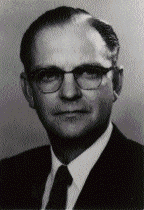
CLIFFORD EDWARD BERRY was born in Gladbrook, Iowa on 19 April 1918 to
Fred Gordon Berry and Grace Strohm. He was the oldest of four children
born to the couple: Clifford, Keith, Frederick, and Barbara.
When Clifford was a small child, his father Fred had an electrical
appliance and repair store in Gladbrook, where he had several electrical
projects. By far the greatest of his projects was a radio--the first radio
in Gladbrook.
This prompted a stream of town visitors to get a glimpse at the
machine. Fred taught his son about the construction of the radio and it
was here that Clifford started tinkering with electricity and radio. When
he was eleven, he built his first ham radio, under his father's
supervision.
From an early age, Clifford was a precocious child. His second grade
teacher and the school principal suggested to his parents that he be moved
a grade ahead. Fred and Grace Berry resisted for two years, until the
principal argued again that Clifford needed to be challenged. He was
allowed to skip the fourth grade.
When he was 11 years old, the family moved to the small town of
Marengo, Iowa, where his father had accepted a position as manager of the
Marengo office for Iowa Power Company. During Clifford's sophomore year at
Marengo High School, where he continued to excel academically, his father
was shot and killed by an employee who had been fired.
At Fred Berry's death, Grace decided the family would remain in Marengo
until Clifford was ready to attend Iowa State College. At that time, they
would all move to Ames, home of the college. From as early as his family
could remember, Clifford had aspired to study electrical engineering. His
father had decided that Iowa State College was the college for Clifford,
since its College of Engineering had a good reputation around the nation.
From the beginning of his college years, his record as a student of
electrical engineering was impressive. He received his B.S. in Electrical
Engineering in 1939. Professor Harold Anderson was a professor of
electrical engineering and one of John Vincent Atanasoff's best friends.
He was also one of the many people that was impressed by Clifford Berry's
brilliance and capacity. Thus, when Atanasoff asked him if he could
recommend a graduate student in electrical engineering to assist him in
his computer-machine project, Professor Anderson immediately thought of
Clifford Berry. When Clifford called Professor Atanasoff to tell him that
he was interested in the job, Atanasoff realized that he was dealing with
an unusual young man.
So, on a morning in the spring of 1939, the two brilliant men had their
first conversation about the concepts and the basic problems they would
have to solve in the construction of the prototype of an electronic
digital computer.
The construction of the prototype moved ahead with great speed and as
soon as it was completed it worked well. It settled their doubts that an
electronic computer could be built. In December 1939 a demonstration of
the prototype to Iowa State College officials convinced them that
Atanasoff's project was worthy of a grant of $850 from the Iowa State
College Research Council to construct a full-scale machine capable of
solving systems of equations. Work on that machine started after the
Christmas holidays.
By late spring the project was well under way, and consideration was
given to the fact that steps needed to be taken to patent the machine, as
well as requesting additional funding for its completion. A 35-page
manuscript Computing Machines for the Solution of Large Systems of
Linear Algebraic Equations, complete with drawings of the machine, was
written by Atanasoff, with Berry's assistance. One copy of this manuscript
was sent in late 1940 to Chicago patent lawyer, Richard R. Trexler, who
had been hired by Iowa State College to give them advice on how to protect
the inventions that were incorporated into the Atanasoff Berry Computer.
When World War II began, the work on the computer came to a halt.
Atanasoff left Ames, Iowa, on leave from Iowa State for a defense-related
position at the Naval Ordnance Laboratory in Washington, D.C. He left the
task of completing the patenting of the ABC to university officials.
It was while Clifford was a graduate student in physics and was working
as a graduate assistant on the ABC that he met Martha Jean Reed, also an
Iowa State graduate who was working in the Physics Department as secretary
to John Atanasoff. The couple wed in May 30, 1942 in Ames, Iowa. They had
two children, Carol and David.
He received his M.S. in Physics in 1941. After their marriage in 1942,
the couple left Iowa for a defense-related job he had been offered with
Consolidated Engineering Corporation in Pasadena, California. Under a
special arrangement with Iowa State, he did his research in absentia and
completed the requirements for the Ph.D. (in physics) in 1948, while
employed by C.E.C.
In 1948 he received the doctorate after presenting a thesis entitled
"The Effects of Initial Energies on Mass Spectra." He became Chief
Physicist at C.E.C. in 1949 and Assistant Director of Research in 1952. He
was made Director of Engineering of the Analytical and Control Division in
1959 and also served as its Technical Director.
In early October 1963 he left C.E.C. to become Manager of Advanced
Development at the Vacuum-Electronics Corporation in Plainview, New York.
He died suddenly on October 30, 1963, before his family had a chance to
join him in New York.
Dr. Berry was issued 19 patents in the area of mass spectrometry, 11
patents in various areas of vacuum and electronics and, at the time of his
death, had 13 patents pending.
He had several articles printed in publications such as: Physics
Review, Instruments, National Bureau of Standards, Journal of
Applied Physics, and Annual Review of Nuclear Science. He contributed a
chapter for the McGraw Hill's Process Instruments and Controls
Handbook.
He was a member of the American Physical Society, American Vacuum
Society, American Association for the Advancement of Science, Sigma Xi,
Eta Kappa Nu, Pi Mu Epsilon, and Phi Kappa Phi.
|| ABC Home || || Current Status || || The
Team || || Public Showings || |
|||||||||||||||||||||||||||||